Why flat-lays lose sales
A customer buying unstitched fabric has to imagine the finished suit. A customer buying a ready-made kurta has to imagine how it falls on a body. A flat-lay answers neither question, so the buyer messages you to ask, or leaves. Photos of the piece on a person answer both at once, and they are the images brands tend to put first on a listing.
The usual way to get them is a model, a studio and a stitched sample. That costs real money per shoot, which is why most brands only photograph their best sellers. Our guide to photoshoot costs in Pakistan works through those numbers.
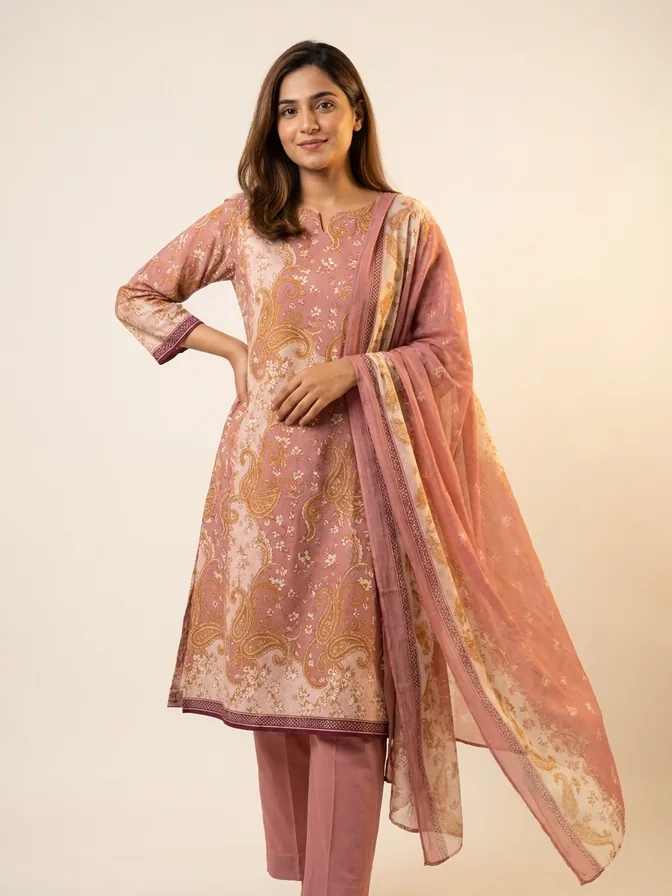
How it works, in four steps
- Photograph the fabric or garment. One clear photo per design.
- Upload it to Aaina Dekho Studio. For unstitched pieces, choose the cut you want to show, such as straight kurta, A-line or sharara.
- Pick a model and a pose. Choose one that suits your customers. Hijab and dupatta styling are supported.
- Check, then publish. Compare the result with the real fabric before it goes on your store.
Because no sample is stitched, one upload can be shown in several cuts and the same print in several colourways. That is the main saving for lawn brands with long catalogues.
Taking the fabric photo
- Shoot in daylight near a window, not under a yellow bulb.
- Lay the fabric flat and shoot straight down so the print is not stretched.
- Show the full design, including borders, and keep shadows and folds away from the print.
- For stitched pieces, use a hanger or flat-lay with the whole garment in frame.
If you would rather build a stitched-suit look the traditional way, our guide to photographing unstitched lawn yourself compares the four approaches.
What it suits and what it doesn't
It works well for printed and lightly embroidered lawn, cotton, linen and everyday ready-to-wear, where a buyer mainly needs to see the cut and the print on a body.
Use a real shoot for heavy zardozi and tilla, sheer organza and net, mirror work and sequins, and any piece where an exact shade decides the sale. Colour is close, not guaranteed, so keep the true colour in your description.
Want shoppers to try pieces on themselves? The try-on widget for your product pages does that.
Frequently asked questions
Can I get model photos for my clothing brand without hiring a model?
Yes. AI model photography takes a photo of your fabric or garment and shows it on a generated model, so you skip the model fee, the session and the stitched sample. It works best on prints, plain and lightly embroidered lawn, cotton and linen. Heavy zardozi, sheer net and exact colour matching still call for a real shoot.
What photo do I upload for unstitched lawn?
A flat, evenly lit photo of the fabric from above, in daylight, with the whole print visible and no shadows or folds across it. One photo can then be shown as different cuts such as a straight kurta, A-line or sharara.
Will the model photos match my fabric colour?
Close, not exact. Always check the result against the fabric before you publish, and keep your real colour in the product description. If a shade decides the sale, photograph that piece for real.
Is it free?
Aaina Dekho Studio is free during its beta, with a small number of free images each day.